
How does OpenAI compare with NLP Cloud? Both platforms propose advanced AI models for text understanding, text generation, embeddings, text to image, and speech to text. But there are important differences in terms of features, pricing, and terms of service.
In this article, I will make an in-depth comparison between OpenAI and NLP Cloud.
Usage Restrictions
OpenAI is very restrictive about the kind of applications it allows. Until November 2022 you had to explicitly ask OpenAI to review and approve your application before going into production. Since then, here is what they say: “We no longer require you to register your applications with OpenAI. Instead, we’ll be using a combination of automated and manual methods to monitor for policy violations.”
Some applications are simply not allowed by default, like applications based on paraphrasing and rewriting (considered as “plagiarism”), multi-level marketing, sexual discussions… Moreover, they often require that you explicitly tell your end users that you are using AI in your application (this is the case for summarization, news generation, and anything related to the medical, legal, and financial industries). Here are the OpenAI’s usage policies:
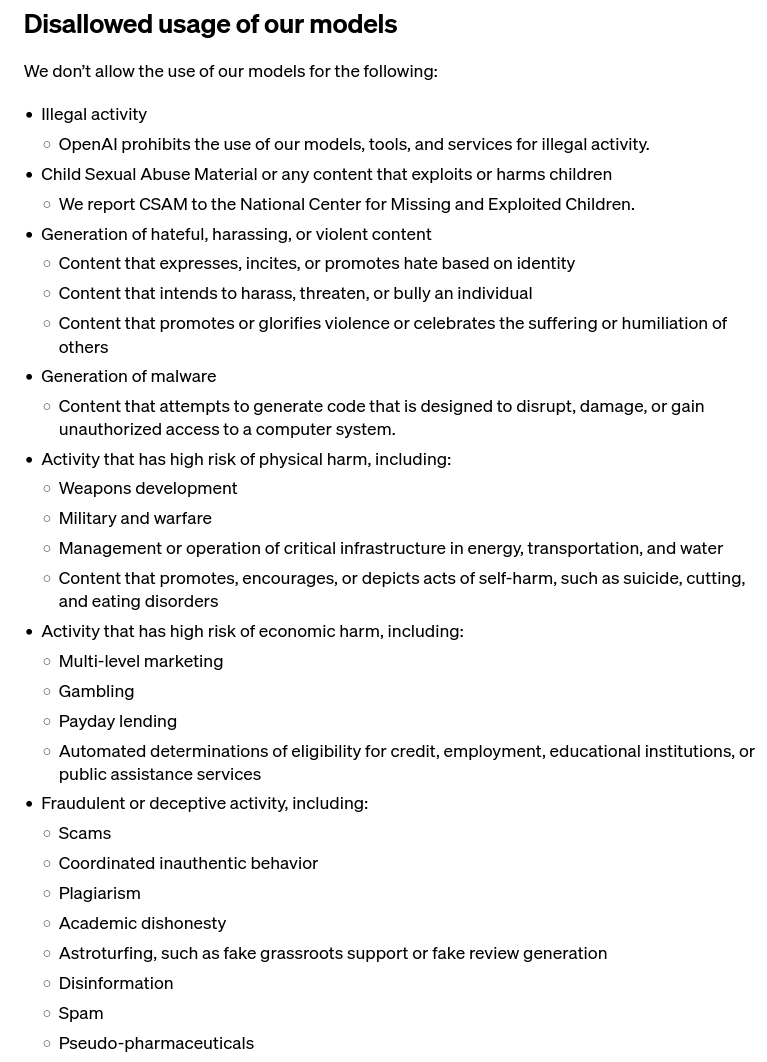
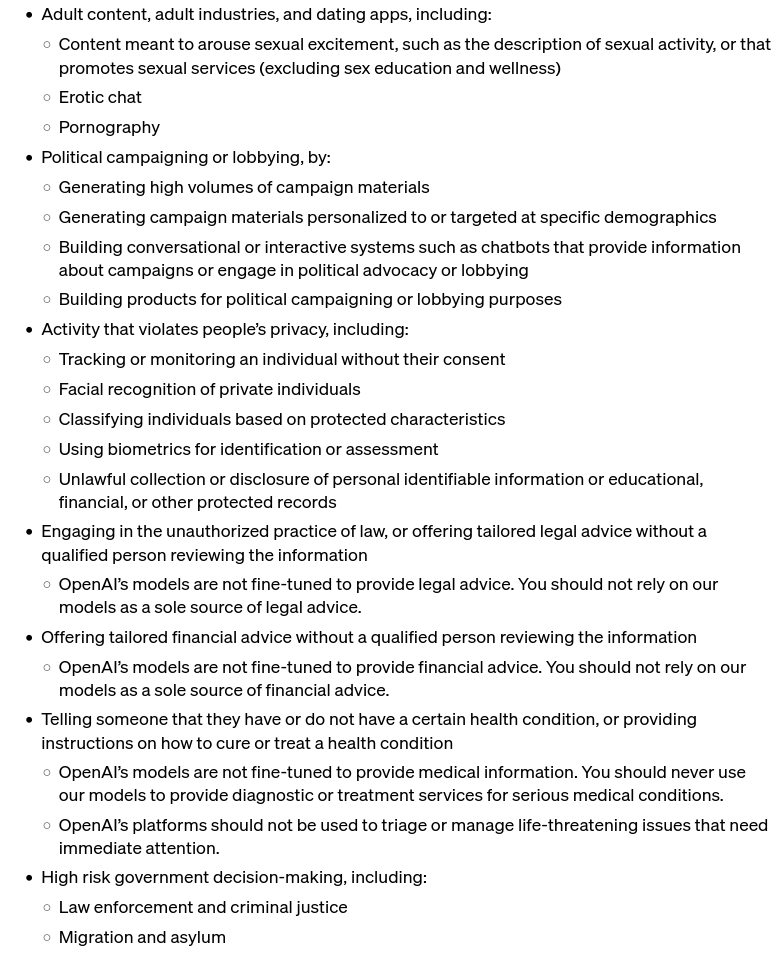
At NLP Cloud, I believe customers should use their best judgement to decide how to use the AI models based on their local laws and their personal ethics. I do not think it is NLP Cloud’s role to inspect and filter customer requests.
Data Privacy
There is a significant difference between OpenAI and NLP Cloud when it comes to data privacy.
OpenAI does many things out of customers’ data. Data sent to OpenAI is reviewed and used for all sorts of things. The most important part is that your data is stored for an unlimited period and used to train and improve OpenAI’s AI models like ChatGPT. See an extract from OpenAI’s privacy policy below:
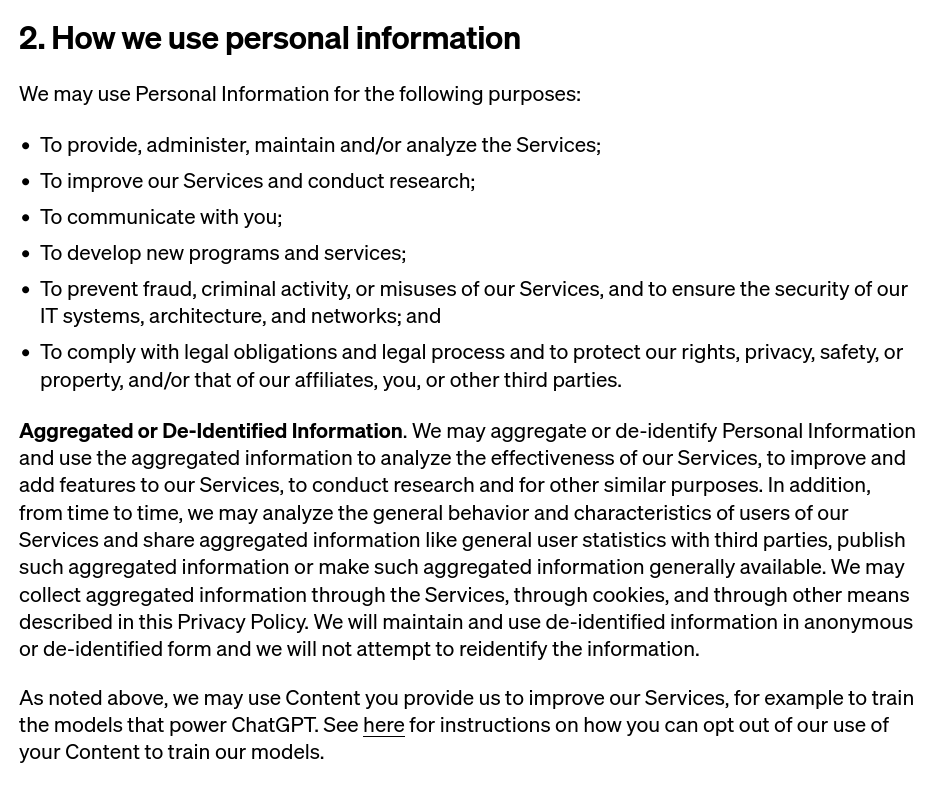
These privacy considerations can be critical for many businesses, especially those dealing with data-sensitive industries like healthcare, legal, finance…
NLP Cloud is HIPAA / GDPR / CCPA compliant, and working on the SOC 2 certification. NLP Cloud cannot see your data, does not store your data, and does not use your data to train its own AI models.
Pricing Differences
OpenAI and NLP Cloud both propose pay-as-you-go prices. It means that you can pay after the fact, only for the number of requests or tokens you actually consumed.
NLP Cloud also proposes standard packages paid upfront. These plans give you access to a specific number of requests per minute. These plans are more cost-effective than pay-as-you-go if you have a large volume of requests to perform, as they help NLP Cloud predict consumption and scale the service accordingly in advance.
See OpenAI’s pricing below:
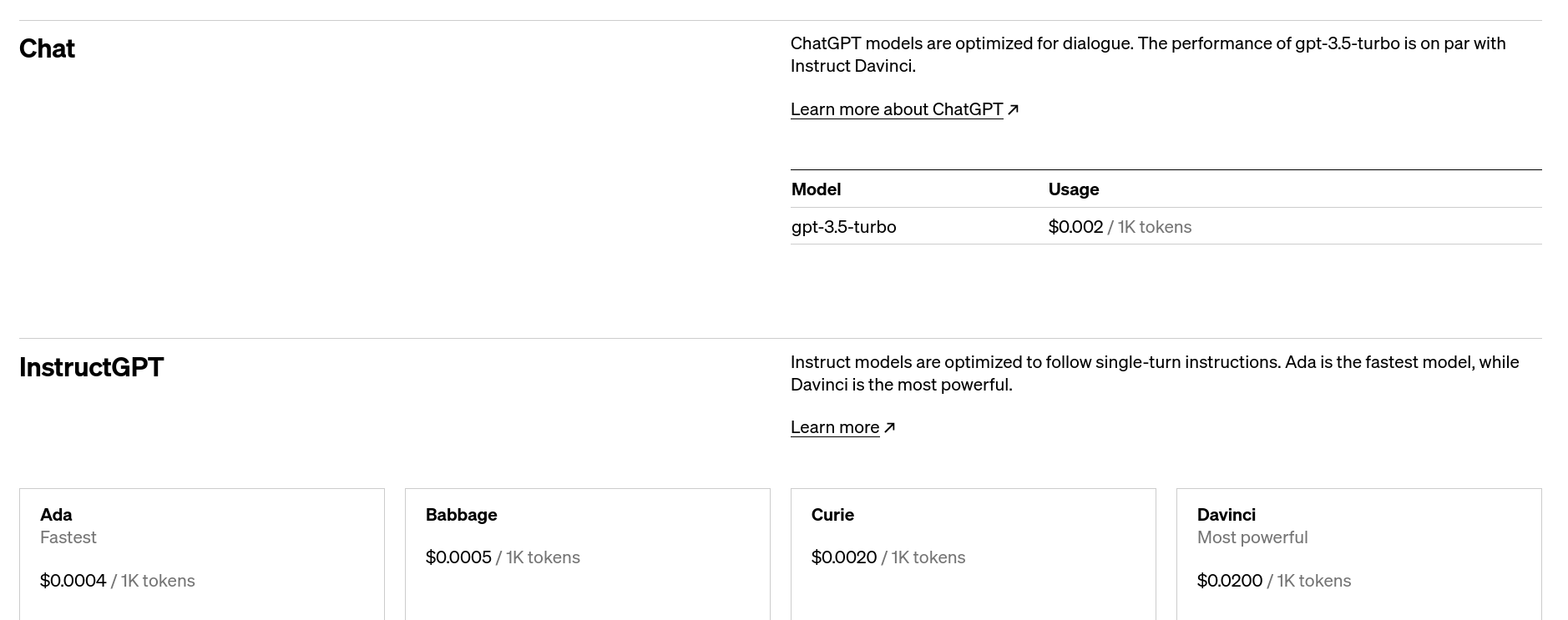
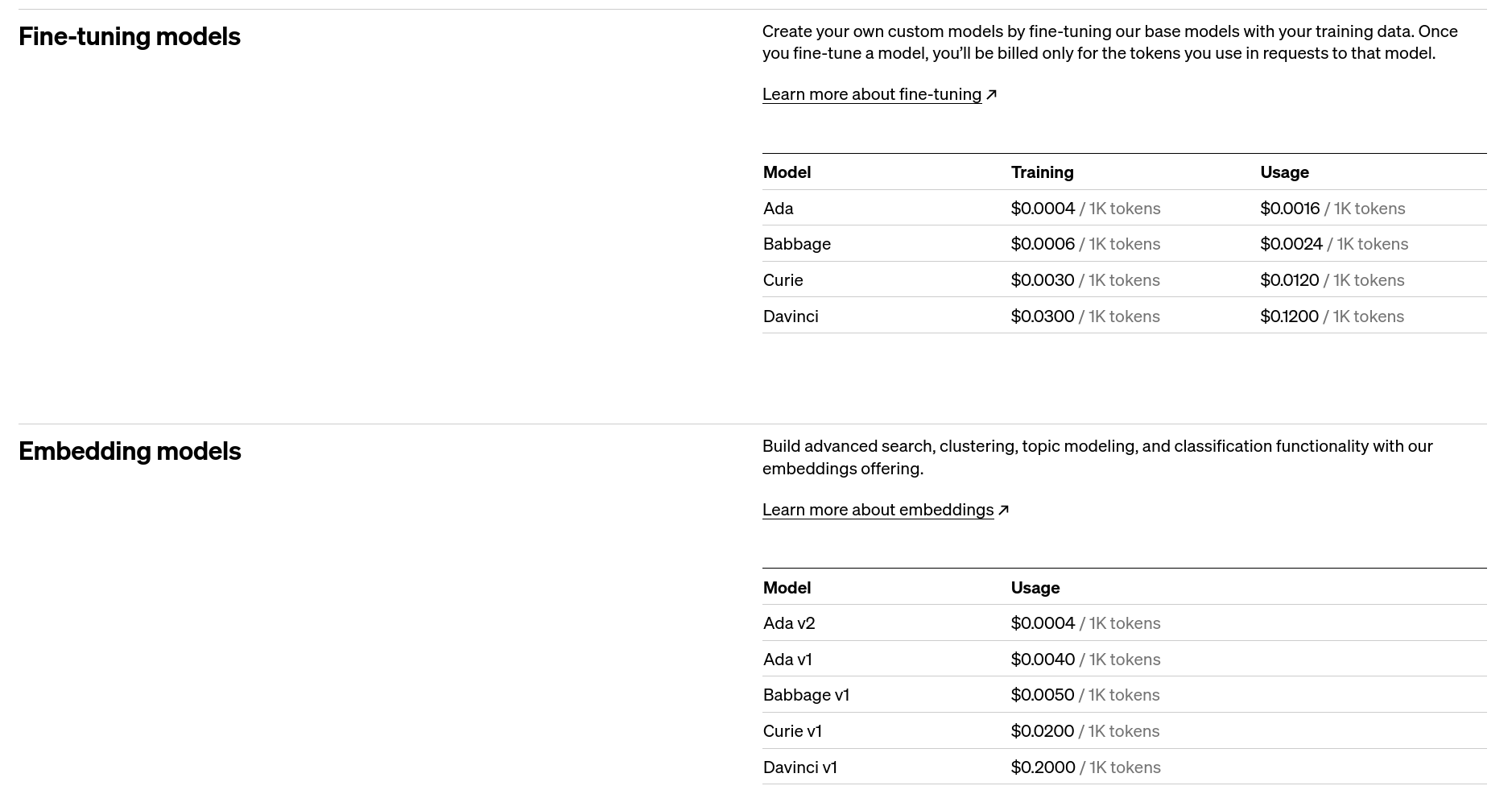
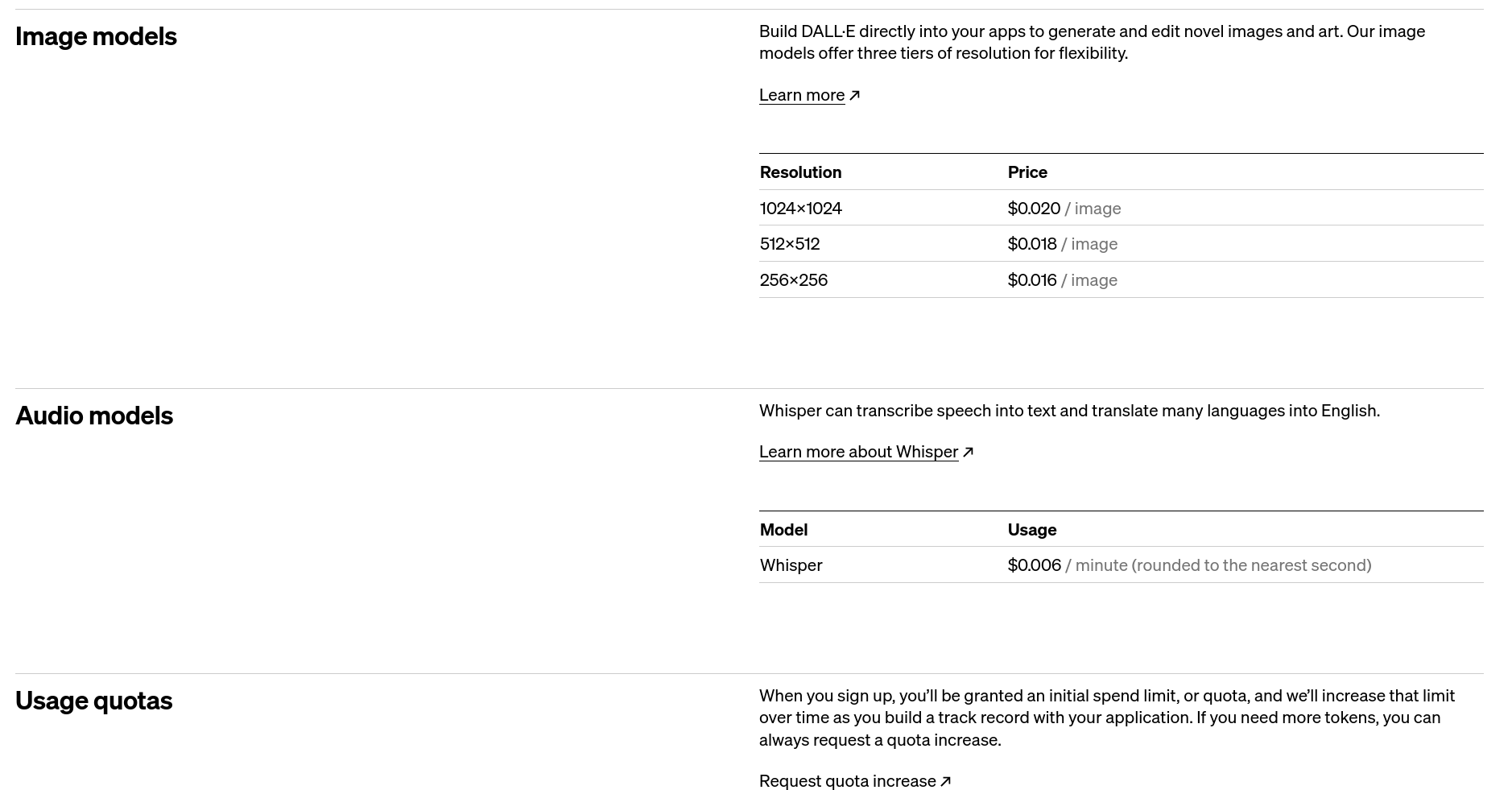
Let’s make a simple simulation. ChatDolphin is equivalent to ChatGPT (GPT 3.5 Turbo), so I am going to compare both prices.
On NLP Cloud, making 20 requests per minute on ChatDolphin, using 2048 tokens each, will cost you $699/month (Enterprise GPU plan).
On OpenAI, it will cost you 0.002/1000 x 2048 x 20 x 60 x 24 x 31 = $3,656/month.
The price difference is very significant, and it is actually even more important when comparing other features like fine-tuning, semantic search, embeddings, speech-to-text, text-to-image…
For example, making 5 speech-to-text requests per minute on Whisper Large, each audio file lasting 200 seconds, will cost you $699/month (Enterprise GPU plan).
On OpenAI it will cost you (0.006/60) x 200 x 5 x 60 x 24 x 31 = $4,464/month.
One last example with image generation. NLP Cloud uses Stable Diffusion, which is equivalent to OpenAI DALL-E. Making 5 image generation requests per minute on Stable Diffusion in 768 x 768 px format will cost you $699/month (Enterprise GPU plan).
On OpenAI, using the 512 x 512 px format (which is lower than 768 x 768) it will cost you 0.018 x 5 x 60 x 31 x 24 = $4,017/month.
Features And Models Available
OpenAI and NLP Cloud adopted 2 very different strategies: OpenAI builds a couple of in-house models (GPT-3, ChatGPT, GPT-4, DALL-E…) while NLP Cloud mixes open-source AI models (Bart, MPNet, Stable Diffusion…) with in-house models (Dolphin, ChatDolphin, …) on the same platform.
It means that on NLP Cloud you can of course use some ChatGPT competitors like GPT-NeoX and ChatDolphin, but you can also use many other models like Bart, T5, Distilbert, spaCy, etc.
Using specialized smaller models is often much more cost effective and much faster than using huge generative AI models.
Sometimes, some use cases just cannot be covered by regular AI models. That’s the case with multilingual AI for example. If you want to use AI in 200 languages, you can use NLP Cloud’s multilingual addon (free of charge). OpenAI does not propose so many languages for the moment.
Leveraging specialized models is also a good way to decrease complexity. For example, performing summarization with GPT-3 or ChatGPT will require some prompt engineering, while you can very simply get advanced results thanks to dedicated pre-trained models like Facebook’s Bart Large CNN.
Last of all, NLP Cloud proposes an “asynchronous” mode, meaning that you can trigger long running background jobs. It is useful for example if you want to summarize very large documents (up to 1 million tokens), or transcribe very long audio files. OpenAI doesn’t propose such a feature.
Reliability, Quota, And Quality Of Support
When comparing OpenAI and NLP Cloud I encourage you to look into 3 additional aspects: reliability of the API, quota, and quality of support.
OpenAI has experienced many severe service interruptions these last months, especially since the release of ChatGPT and GPT-4. They also faced bugs that led to critical security breaches recently, which scared many customers.
Learn more about recent OpenAI security issues here.
NLP Cloud provides a robust infrastructure and has not faced any significant service outage since March 2020 (caused by a fire in an OVH datacenter).
Also, it is important to note that OpenAI automatically applies severe quotas to new users. Basically, if you are a new user, you will need to wait for a while and apply for additional quotas before moving your application to production. NLP Cloud does not apply such quotas, so you can go to production instantly.
Last of all, it is in general quite difficult to get a prompt and elaborate response from the OpenAI support. NLP Cloud answers questions about prompt engineering, model selection, fine-tuning, and similar topics.
Conclusion
Many customers are looking for alternatives to OpenAI, mainly because of their use case restrictions, data privacy policy, pricing, and service disruptions.