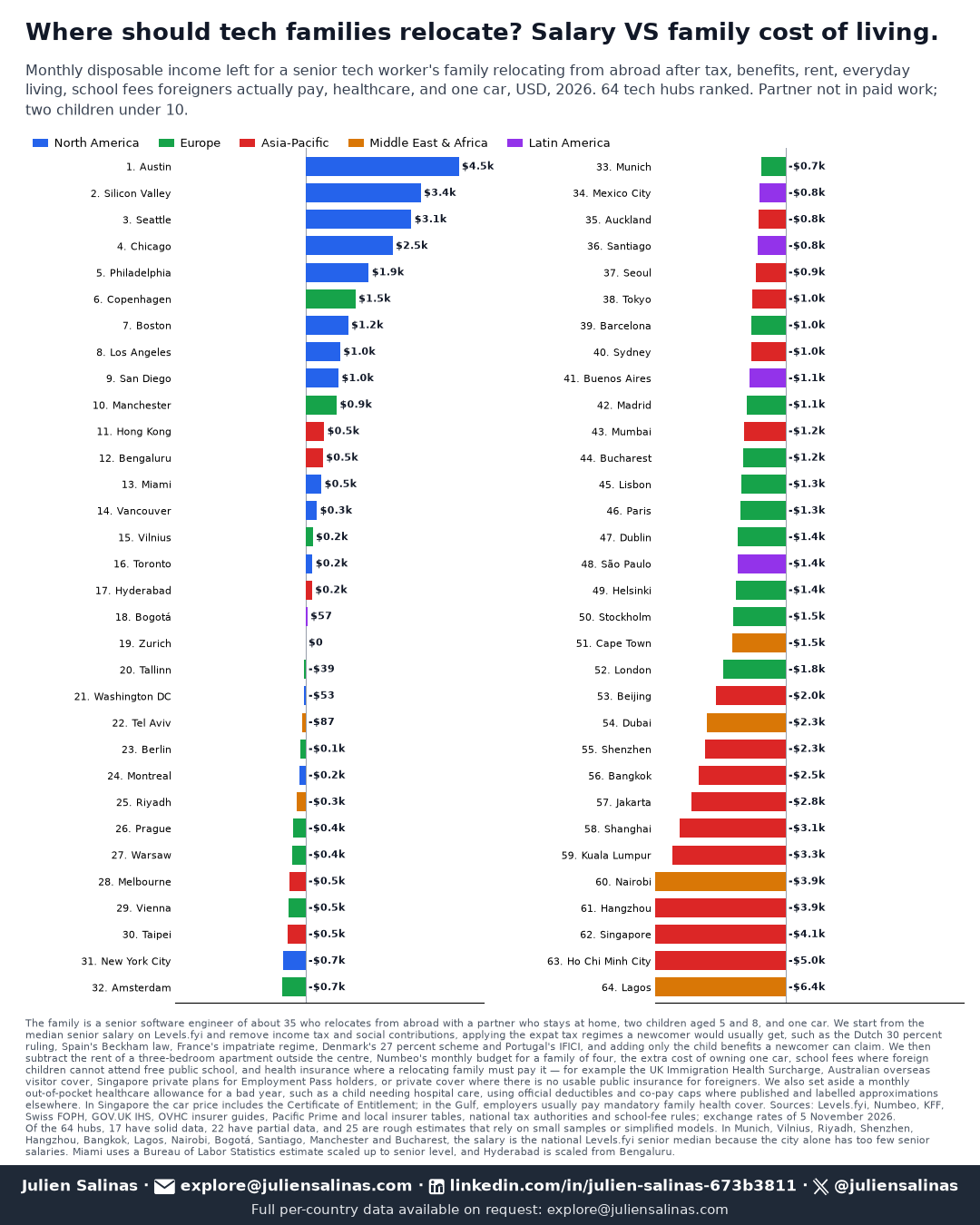
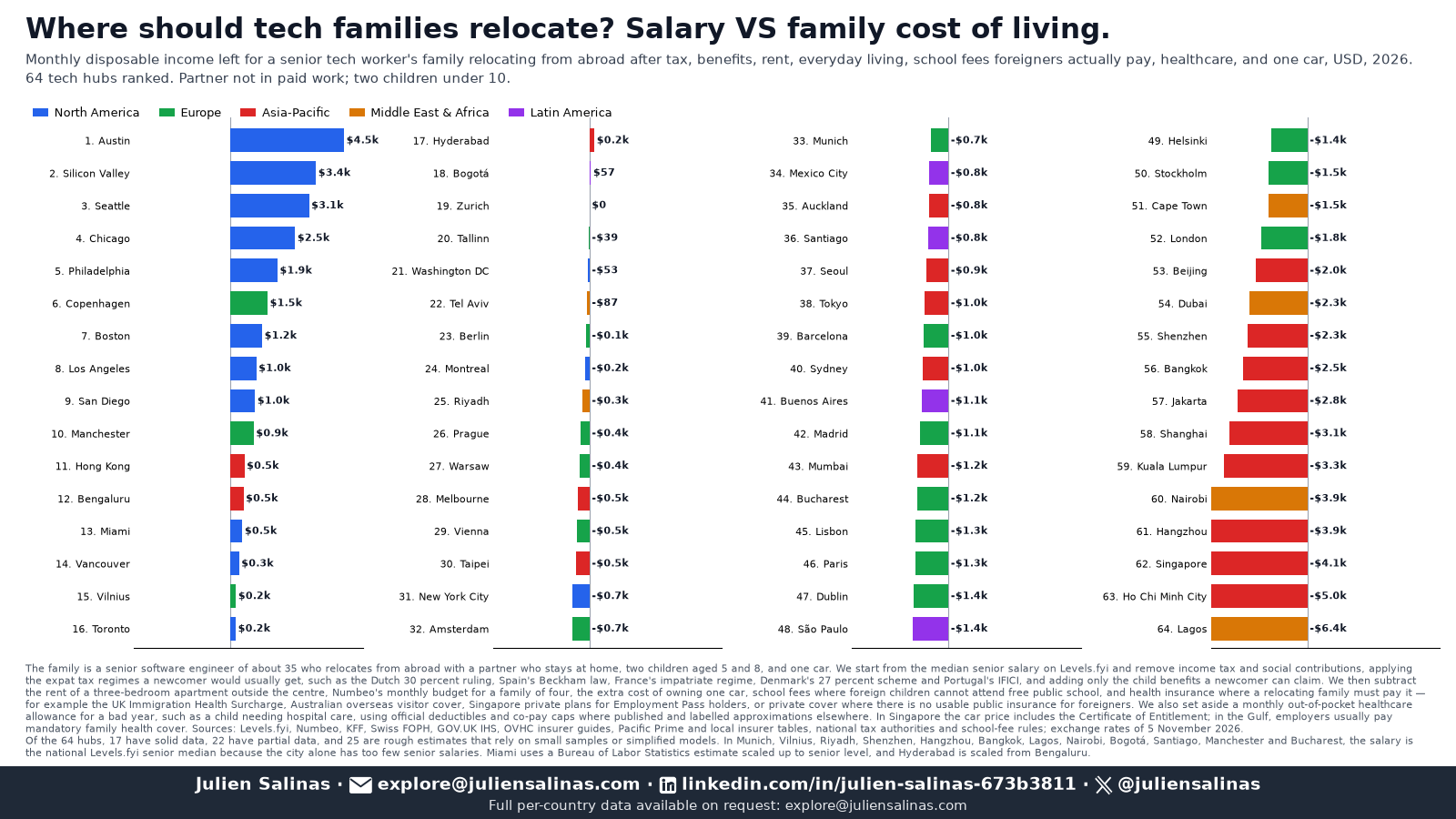

A senior software engineer who relocates with a family does not face the same bill as a single engineer renting a one-bedroom flat. The partner stays home, two children need school and healthcare, and one car is part of daily life. I rebuilt my earlier purchasing-power ranking for that household, across the same 64 tech hubs, and asked a sharper question: what is left each month after tax, benefits, rent, everyday living, school fees that foreigners actually pay, healthcare, and the car.
The answer changes once you stop thinking like a long-settled local and start thinking like a family that has just arrived on a work permit.
Who this ranking is for
The persona is the same everywhere: a senior software engineer of about 35, a partner who is not in paid work, two children aged 5 and 8, and one car. The salary is the Levels.fyi senior base median for each hub. Everyday living costs come from Numbeo’s family-of-four basket excluding rent. Housing is a three-bedroom apartment outside the city centre, which is more realistic for a family with a car than a centre flat.
I framed every tax, benefit, school and healthcare choice for a family relocating from abroad, not for someone who has lived in the country for years. That framing is the whole point of this study.
Why the relocating lens changes the numbers
Special tax regimes that newcomers often receive matter a lot. In the Netherlands I applied the 30 percent ruling. In Spain I used the Beckham law flat rate of 24 percent on employment income. In France I applied the impatriate regime that exempts 30 percent of taxable pay from income tax. In Denmark I used the 27 percent key-employee scheme, and in Portugal the IFICI flat rate of 20 percent for qualifying technology specialists. Ireland’s special assignee relief and Sweden’s expert tax were left out, because a typical direct local hire would not usually qualify.
Child benefits are another trap. Canada’s child benefit needs 18 months of continuous residency before a temporary resident can claim it, so I excluded it for a newly arrived family. Singapore’s baby bonus is for citizens only. Typical United States work-visa families keep the child tax credit when the children have Social Security numbers. Most European child allowances remain available to resident work-permit holders, and those stay in the model.
School is not free for foreigners everywhere. In 48 of the 64 hubs, public primary school is open to resident children of work-permit holders at no tuition, so I used zero. In Singapore, non-ASEAN pupils at government or government-aided primary schools pay Ministry of Education fees that add up to about 1,639 dollars a month for two children. In 15 hubs, including Dubai, Riyadh, the Chinese cities, India, much of Southeast Asia, Lagos and Nairobi, relocating tech families typically use private or international schools, so I used a mid-range private or Numbeo international primary cost for two children.
Healthcare follows the same relocating test. Where a foreign family must buy cover, I included it: the United Kingdom Immigration Health Surcharge of 1,035 pounds a year per adult and 776 pounds a year per child, Australian overseas visitor cover for work-visa holders, Singapore private plans for Employment Pass holders, and mid-range private cover where public insurance does not usefully cover foreign dependents. In Dubai and Riyadh the employer must insure the family, so the employee premium is zero. In the United States, Switzerland and the Netherlands the mandatory employee share was already in the model. I also set aside a monthly out-of-pocket allowance for a bad year, such as a child who breaks a leg and goes to hospital, using official deductibles and co-pay caps where they are published and labelling the rest as approximations.
What the ranking shows
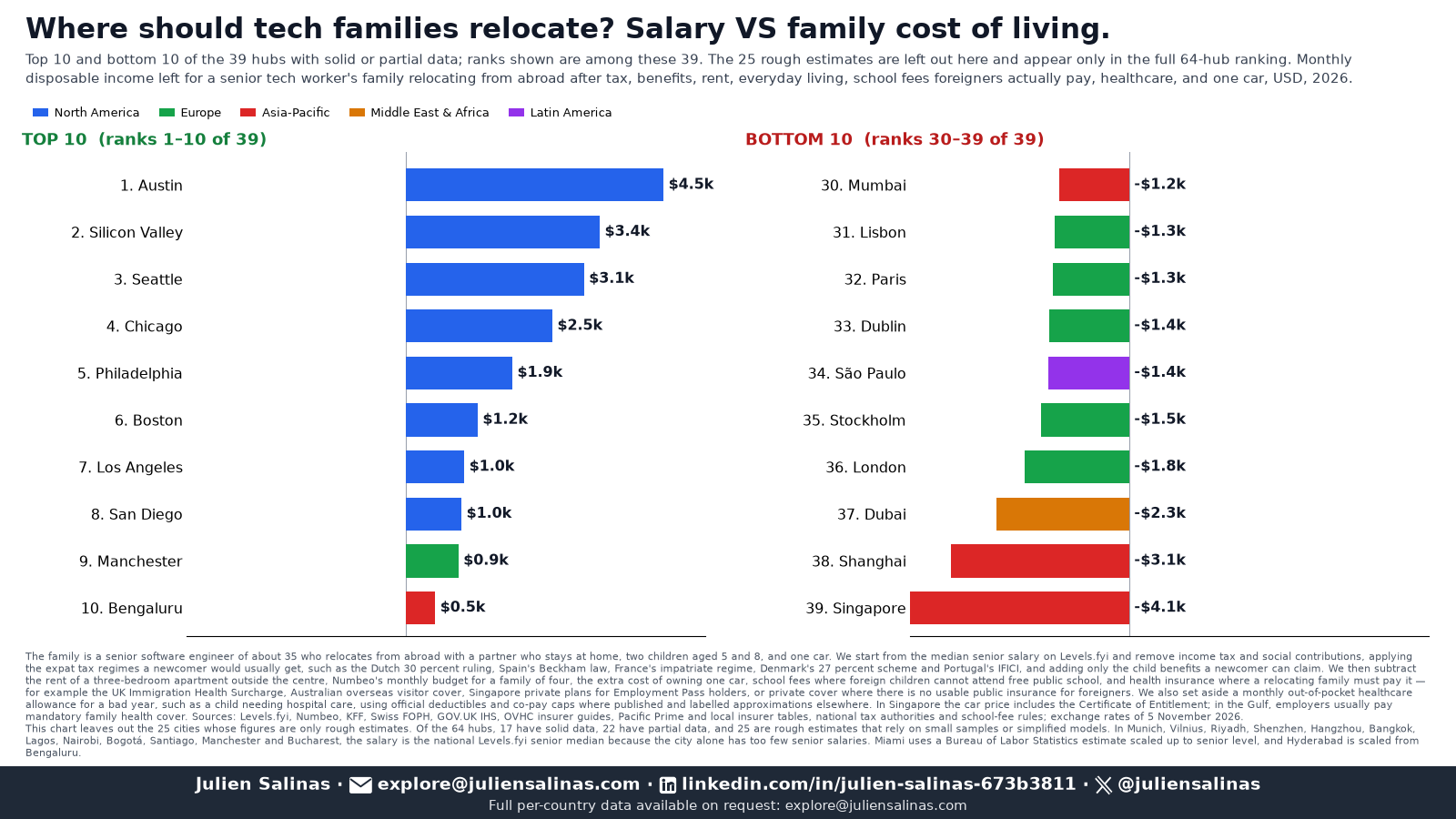
United States cities still dominate the top of the list, even after family healthcare. Austin leaves about 4,473 dollars a month. Silicon Valley follows at about 3,366, then Seattle at 3,093, Chicago at 2,544 and Philadelphia at 1,850. Boston, Los Angeles and San Diego stay in the top ten as well. That lead survives the average employee share of a family health premium and a bad-year deductible of about 163 dollars a month.
Copenhagen appears high in the full ranking, around 1,461 dollars a month, helped by Denmark’s 27 percent scheme for highly paid newcomers. That figure rests on a thin salary sample and is marked as a rough estimate, so it should be read with caution. Among the 39 hubs with solid or partial data, Manchester is the strongest European city in the top ten, at about 914 dollars a month after the United Kingdom health surcharge.
Zurich, often treated as a high earner’s paradise, breaks even at zero once Swiss mandatory health premiums and a modest out-of-pocket allowance are included. Toronto leaves about 207 dollars a month, and Vancouver about 336, both without Canada’s child benefit in the first year. Montreal slips slightly negative.
London is a clear warning for a relocating family. After tax, the health surcharge of about 407 dollars a month for this household, and a three-bedroom rent outside the centre of about 3,782 dollars, the city leaves a shortfall of about 1,813 dollars a month. New York City is also negative, at about 663 dollars short, because rent and healthcare overwhelm a high gross salary.
Singapore and many Asian and African hubs turn sharply negative once school and private health enter the picture. Singapore leaves a shortfall of about 4,089 dollars a month: the car price includes the Certificate of Entitlement, government school fees for non-ASEAN pupils add about 1,639 dollars, and private health for an Employment Pass family adds hundreds more. Dubai is negative mainly because of international school costs, even though the employer pays mandatory health cover. Lagos sits at the bottom with a shortfall of about 6,424 dollars a month. Across the full list, 18 hubs leave a surplus, Zurich breaks even, and 45 leave a shortfall.
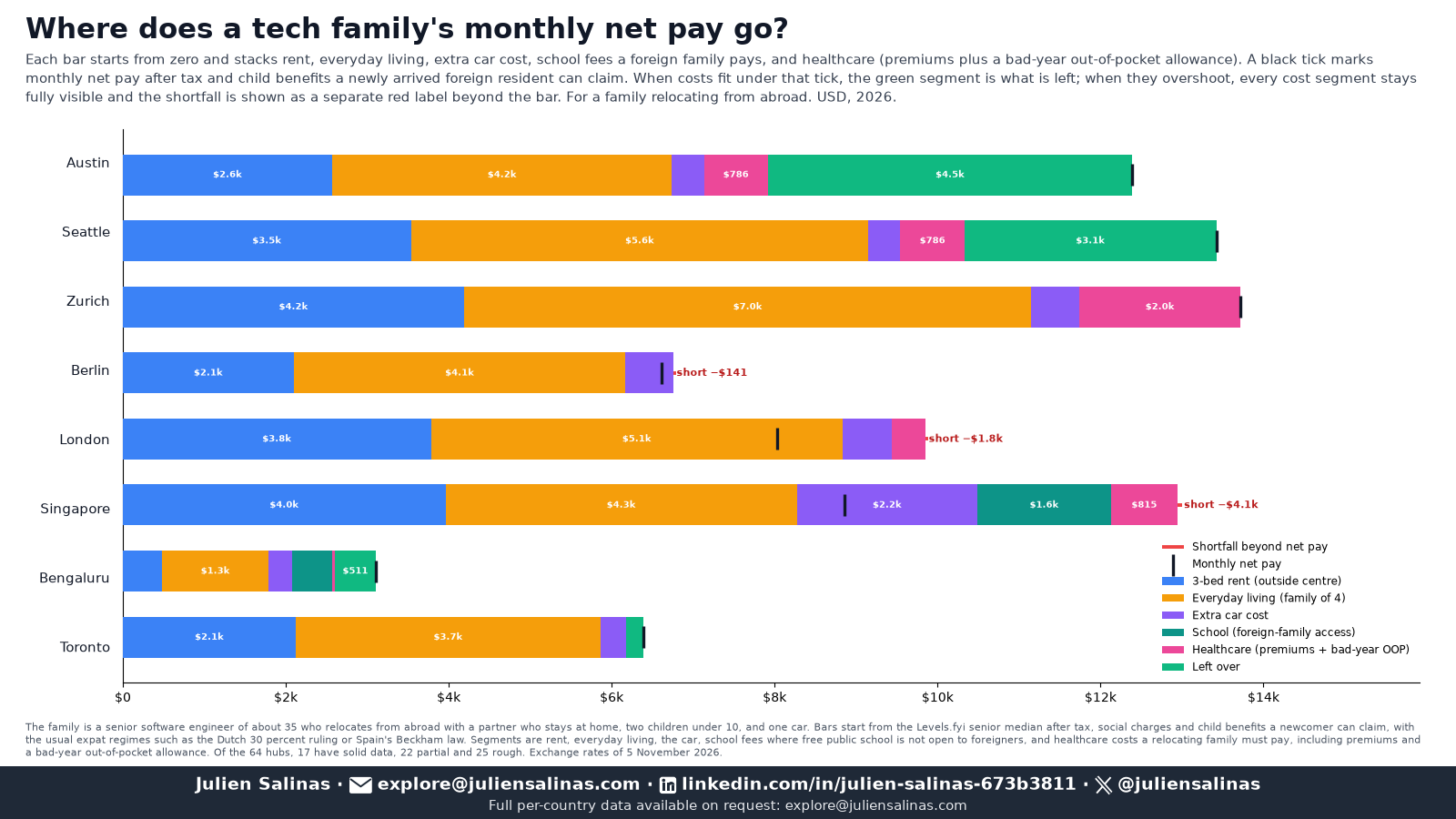
The stacked view makes the same point city by city. In Austin and Seattle, net pay still covers rent, living costs, the car and healthcare, with thousands left over. In Zurich the pieces fill the net-pay tick almost exactly. In London and Singapore the cost bar runs past net pay, and school or healthcare are visible reasons why.
What this means if you are thinking of moving
A high gross salary is not enough for a family move. The places that look generous for a single engineer can shrink once a non-working partner, two children, school access and real healthcare rules are included. United States hubs keep a structural advantage for this persona, but only if the visa and the family health plan are realistic. European cities with strong expat tax regimes improve for newcomers, yet rent and health surcharges can erase that gain. Hubs that push foreign children into private school, or foreign workers into private health insurance, need a much higher salary than the headline Levels.fyi number suggests.
I would treat gaps of a few hundred dollars between neighbouring cities as noise, especially where the salary sample is thin. The useful signal is the large gap between the leading United States cities, the break-even European cases, and the deep shortfalls where school and private health dominate.
How I built it
Salaries are Levels.fyi Software Engineer senior base medians, accessed on 5 November 2026. Where a city has no senior page of its own, I used the national Levels.fyi senior median for that country: Munich, Vilnius, Riyadh, Shenzhen, Hangzhou, Bangkok, Lagos, Nairobi, Bogotá, Santiago, Manchester and Bucharest. Miami uses a Bureau of Labor Statistics estimate scaled to senior level, and Hyderabad is scaled from Bengaluru.
Taxes, social contributions and child benefits follow each country’s 2026 rules for a single-earner couple with two children, with the relocating adjustments described above. Rent is Numbeo’s three-bedroom apartment outside the centre. Everyday living is Numbeo’s family-of-four estimate excluding rent. The car is a Toyota Corolla paid off over five years, minus the small share of car costs already inside Numbeo’s basket, plus extra fuel and a simple insurance estimate; in Singapore the Numbeo car price includes the Certificate of Entitlement.
School classifications and fees are documented city by city. Healthcare premiums and the bad-year out-of-pocket allowance are documented with sources; some private premiums and some out-of-pocket figures are labelled approximations. All amounts are in United States dollars at 5 November 2026 spot rates.
Of the 64 hubs, 17 have solid data, 22 have partial data, and 25 are rough estimates that rely on small samples or simplified models. Read the ranking for large differences, not for fine rankings among rough cities.
Full per-country data is available on request: explore@juliensalinas.com.
If you have relocated with children and your experience differs from this picture, tell me which city and what I should adjust.