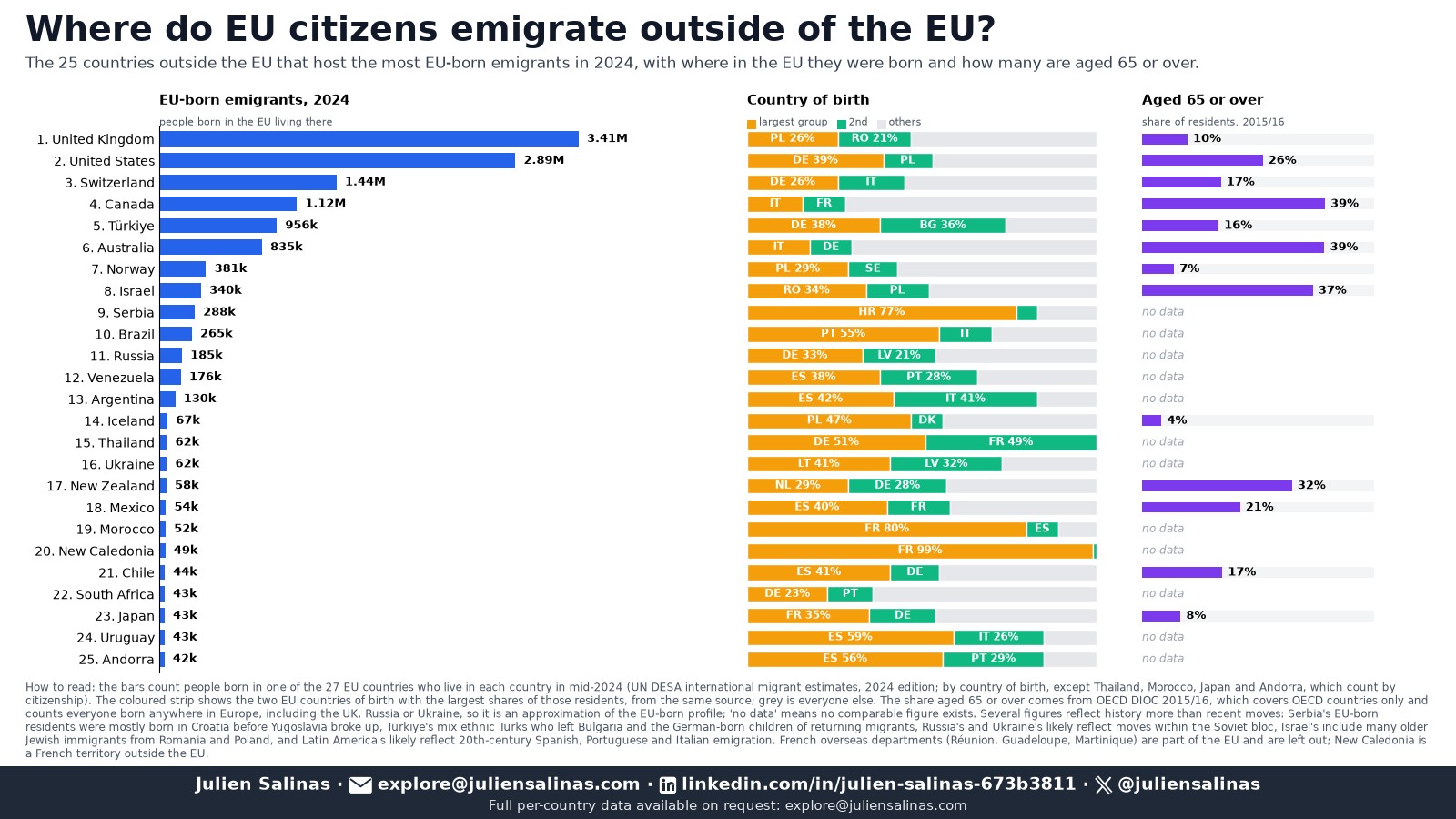

When EU citizens emigrate, a little over half of them settle in another EU country, which free movement makes easy. Yet millions do leave the EU altogether, and I wanted to know where they go. The answer is less obvious than it seems: the top 25 emigration destinations outside the EU include Canada and Australia, as you would expect, but also Türkiye, Serbia, Brazil and Russia, and the people behind each figure turn out to be very different.
What the numbers measure
Every figure in the main ranking is the total number of EU-born emigrants living in a given country in mid-2024, that is, people who were born in one of the 27 EU countries and now reside in that destination. It is not a yearly flow: it adds up everyone who emigrated there, whether they moved last year or fifty years ago. That distinction matters, because it explains why some destinations rank high for reasons that have more to do with history than with relocation today.
The UK and the US lead by far
The United Kingdom is the first emigration destination outside the EU, with 3.41 million EU-born residents, and the United States comes second with 2.89 million. Together they account for almost half of the 13 million EU-born emigrants counted across the top 25. Switzerland (1.44 million) and Canada (1.12 million) are the only other countries above one million, followed by Türkiye (956,000) and Australia (835,000).
Beyond the top six, the figures drop quickly. Norway hosts 381,000 EU-born emigrants, Israel 340,000 and Serbia 288,000, and the last places on the list, Japan, Uruguay and Andorra, each host a little over 40,000.
Who goes where
The country of birth changes completely from one destination to the next. Poles and Romanians make up almost half of the EU-born emigrants in the UK (26% and 21%), which likely reflects the large movement that followed their countries’ accession to the EU. Germans are the largest group in the United States (39%) and in Switzerland (26%), while Italians remain the first group in Canada (16%) and Australia (18%).
Shared languages and old historical ties likely play a role too. Portuguese-born emigrants make up 55% of the EU-born population in Brazil, Spanish-born emigrants make up 59% in Uruguay and 42% in Argentina, and people born in France account for 80% in Morocco and 99% in New Caledonia, which is a French territory outside the EU. Thailand, for its part, splits almost evenly between Germans and French.
Retirees in some places, younger arrivals in others
Age is where the contrast is sharpest. In Canada and Australia, 39% of the European-born residents are aged 65 or over, and the share reaches 37% in Israel, which likely reflects waves of emigration that took place decades ago. In the United Kingdom, by contrast, only 10% are 65 or over, and the share falls to 8% in Japan, 7% in Norway and 4% in Iceland, likely because most people arrived more recently, many of them to work.
These age shares have an important limit, which I explain in the methodology below: they cover OECD countries only, they date from 2015/16, and they count everyone born in Europe rather than only in the EU.
When history explains the ranking
A few entries reflect history more than recent emigration, and I chose to keep them in the ranking while explaining them rather than dropping them:
- Serbia: 77% of its EU-born residents were born in Croatia before Yugoslavia broke up, which likely explains most of this figure.
- Türkiye: the EU-born population mixes people born in Bulgaria (36%), likely including many ethnic Turks who left in past decades, and people born in Germany (38%), likely including many children of Turkish migrants who returned home.
- Russia and Ukraine: most of their EU-born residents were born in Germany or the Baltic states (Lithuania and Latvia make up 73% in Ukraine), which likely reflects moves within the Soviet bloc.
- Israel: the largest groups were born in Romania (34%) and Poland (18%), and they likely include many older Jewish immigrants.
- Latin America: the Spanish, Portuguese and Italian communities in Brazil, Venezuela, Argentina, Mexico, Chile and Uruguay likely reflect the great waves of 20th-century emigration.
How I built it
- Number of EU-born emigrants: UN DESA international migrant estimates, 2024 edition, table by destination and origin, mid-2024. I added up the 27 EU countries of origin for each destination. Most countries count people by country of birth, but Thailand, Morocco, Japan and Andorra count them by citizenship.
- Main countries of birth: the same UN DESA table, showing the two EU countries that make up the largest shares of each destination’s EU-born population.
- Share aged 65 or over: the OECD Database on Immigrants in OECD Countries (DIOC) 2015/16, based on national censuses and registers. Its public files only break people down by region of birth, so I used everyone born in Europe as an approximation of the EU-born population.
- Scope: I kept every country outside the EU27, including the EFTA countries Switzerland, Norway and Iceland. I left out Réunion, Guadeloupe and Martinique, because these French overseas departments are legally part of the EU.
Limits
The ranking counts all EU-born emigrants, whatever their age, so it includes retirees, children and people who emigrated decades ago. The age data is about ten years older than the main figures, covers only 13 of the 25 destinations, and includes people born in non-EU European countries such as the UK, Russia or Ukraine, so it should be read as an indication rather than an exact profile. I also looked for comparable data on self-employment and household type by EU country of birth, but I did not find any source that covers these destinations consistently, so I left them out rather than guess.
The full per-country data, with the sources and definitions for each destination, is available on request: email explore@juliensalinas.com.
If you spot an error, or know a better source for one of these countries, tell me and I will update the chart.